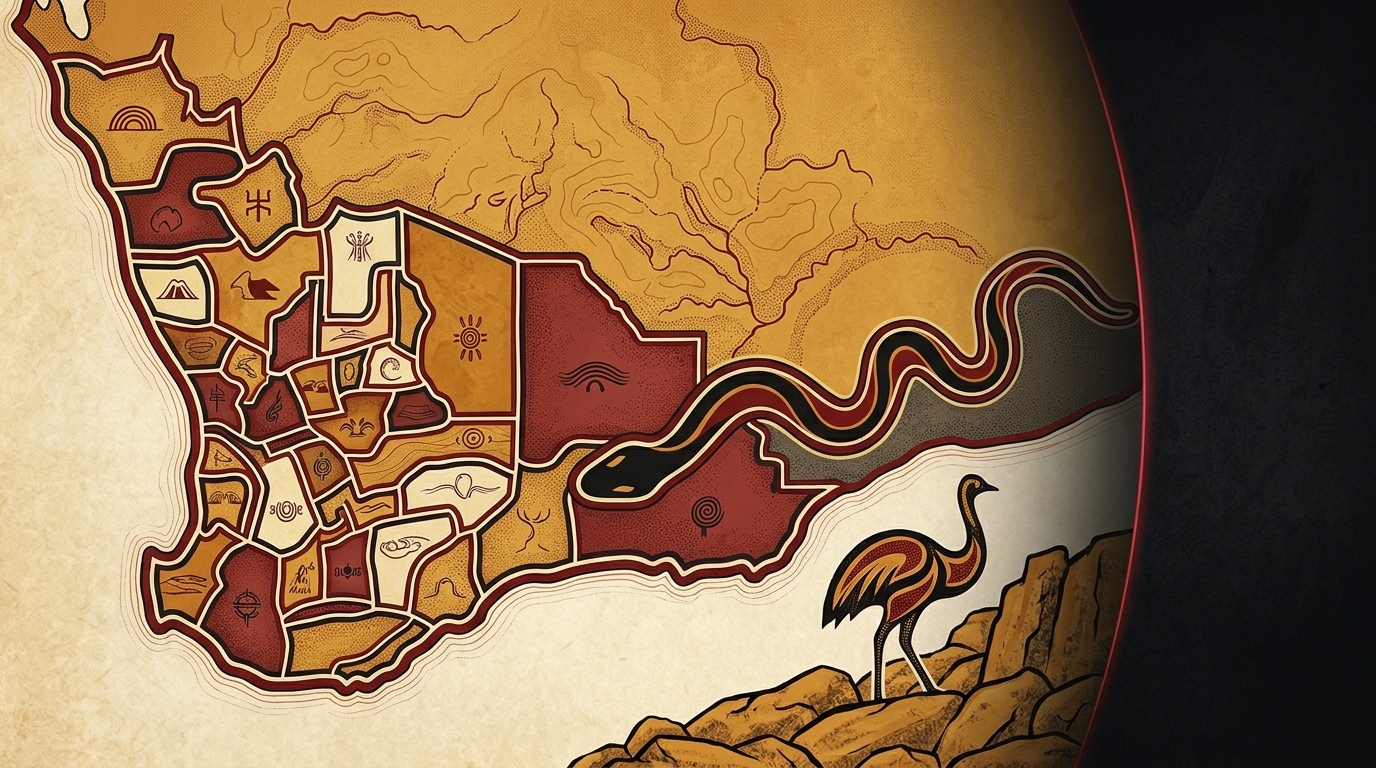
The Jurisprudence Of Arts & Culture: Design Authority, Performance Law & The Ownership Question
BIBBULLMUN SOVEREIGN NATION ARCHIVE • INDIGENOUS & ABORIGINAL CUSTOMARY LAW, NOONGAR & NYUNGAR ETHNOHISTORY, SOUTH-WEST WESTERN AUSTRALIA
Citation: Bibbullmun.com.au, 'The Jurisprudence of Arts & Culture: Design Authority, Performance Law & the Ownership Question' (2026) Bibbullmun Sovereign Nation Archive<https://www.bibbullmun.com.au/arts-culture/jurisprudence.php>.
TABLE OF CONTENTS
1. Art Under Law
Design in the Bibbullmun [BIB-ool-mun] order was never free expression alone: it was authority made visible. Who could paint what, wear what, sing what and where was a matter of custodial right, graded initiation and estate jurisdiction—and the misuse of a design was a legal wrong the community could name and remedy.[1][2] This paper states that legal architecture for the arts-culture category.
2. Design Authority and Performance Law
The rules ran from the body to the ground. Body designs marked lawful standing within the initiation grades;[1] sacred grounds carried their own performance law, entry protocols and closed knowledge;[3] and the regional assemblies that convened the great performances were themselves governed by the protocols of the polities that hosted them.[2] The colonial record preserved fragments of the whole; the archive's art and law collections carry the parts in detail.
3. The Modern Ownership Question
The modern period restated the whole field as a property question the older law had never needed to ask: who owns a design that belongs to a system? The copyright jurisprudence on Aboriginal art has approached the mismatch—individual authorship meeting custodial authority—and the cases are cited in this archive's art collection in full.[4] The international standards now frame the same question, and the Indigenous critical tradition names the politics of the exchange precisely: to own and to represent knowledge is to exercise sovereignty—and the design system had been doing exactly that for millennia before any gallery opened.[5][6]
4. The Paper's Conclusion
A design system with owners, rules and remedies is a jurisdiction. The jurisprudence paper of this category states that conclusion as the archive's position, with every element cited to the sources below—vocabularies and manuscripts for the classical rule, cases and instruments for the modern restatement.
Complete AGLC4 Footnotes & Master References
All primary colonial dictionary entries, legal precedents, and archival sources for this monograph are documented on the dedicated footnotes page.
View Dedicated AGLC4 Footnotes & References Module