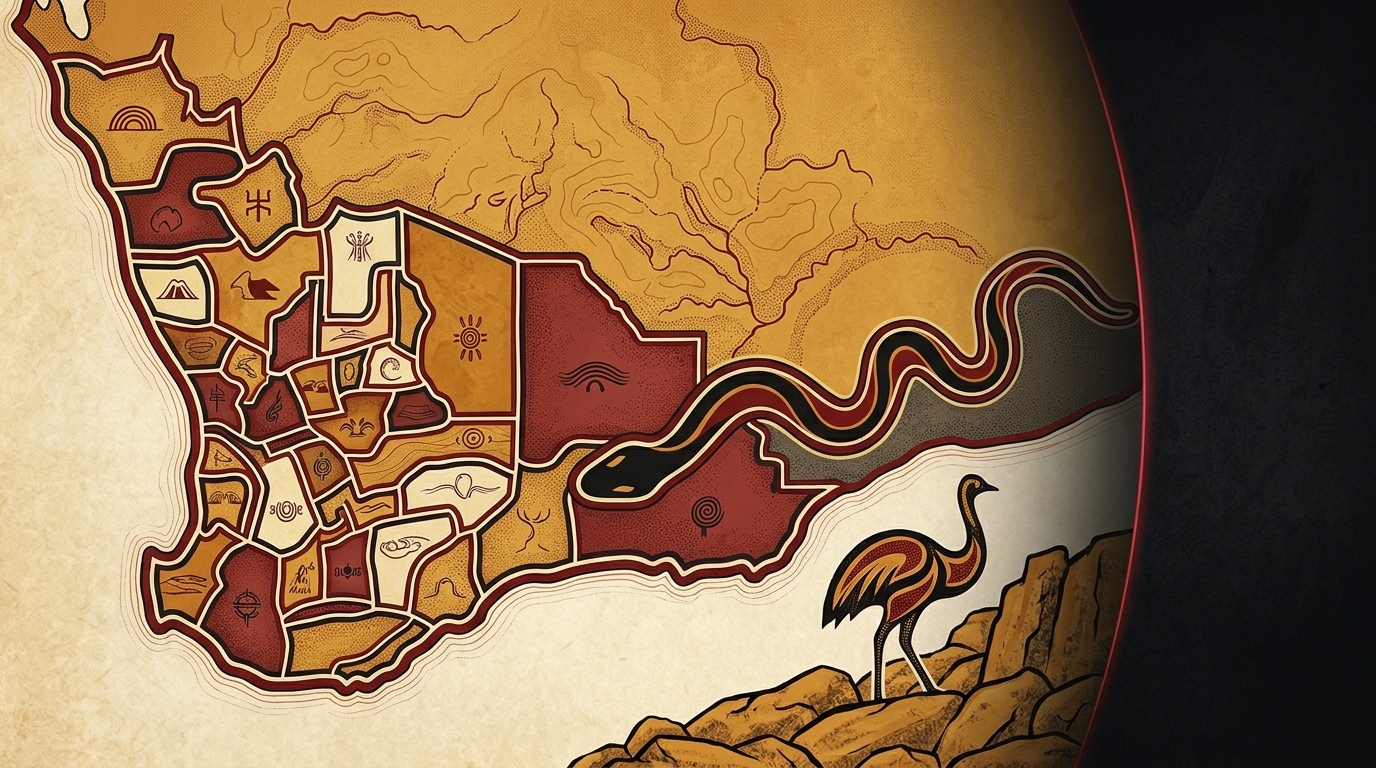
The Koombana-Borung Clan Estate: Tidal Fish Trapping, Estuarine Marine Tenure & Ancient Mangrove Littoral
BIBBULLMUN SOVEREIGN NATION ARCHIVE • INDIGENOUS & ABORIGINAL CUSTOMARY LAW, NOONGAR & NYUNGAR ETHNOHISTORY, SOUTH-WEST WESTERN AUSTRALIA
Citation: Bibbullmun.com.au, 'The Koombana-borung Clan Estate: Tidal Fish Trapping, Estuarine Marine Tenure & Ancient Mangrove Littoral' (2026) Bibbullmun Sovereign Nation Archive<https://www.bibbullmun.com.au/koombana-borung.php>.
TABLE OF CONTENTS
1. Fluvial Geography & Territorial Demarcation
The Koombana-borung [[koom-BAH-nah BOH-roong]] constitutes a localized customary clan estate (kalla-boodja [KAHL-lah BOOD-jah]) nested within the traditional authority of the Wardandi [[WAHR-dahn-dee]] sovereign subnation of the Bibbullmun [BIB-ool-mun] [BIB-ool-mun] Sovereign Nation.[1] Centred around the sheltered waters of Koombana Bay and the extensive Leschenault Estuary, the Koombana-borung estate controlled the vital confluence where the Preston and Collie rivers discharge into the Indian Ocean. The estate encompassed rich estuarine sandbars, samphire saltmarshes, and coastal peppermint (Agonis flexuosa) woodlands.[2]
Under customary estate tenure, physical borders between clan estates were marked not by arbitrary geometric surveys, but by natural fluvial axes, water divides, distinct vegetation belts, and ancestral granite outcrops created during the Nyitting [NYE-ting].[3] The primary drainage lines of the Preston River (Derbal), Collie River & Leschenault Estuary provided both the ecological lifelines of the estate and its recognised jurisdictional limits.[4]
2. Customary Land Tenure & Kalla Fire Husbandry
Custodianship of the Koombana-borung estate was inherited patrilineally through the overarching moiety dualism of Manitchmat [MAH-nitch-maht] (White Cockatoo) and Wordungmat [WAR-doong-maht] (Crow).[5] Primary field genealogies recorded in Daisy Bates Manuscript 365 confirm that custodial families exercised exclusive rights to fire, forage, and harvest within their designated boundaries.[6]
Fire management (kalla) was conducted with meticulous ecological precision. Cold mosaic burns were applied during the cooler transitional seasons to clear dense undergrowth, prevent catastrophic wildfires, and promote fresh green shoots that attracted game animals, embodying the ancient reciprocal obligation to care for country.[7]
3. Ecological Economics & Material Civilisation
The custodians operated sophisticated tidal brushwood weirs and stone traps across the narrow estuary channels, harvesting vast seasonal migrations of sea mullet, yellow-eye mullet, and blue swimmer crabs. Marine resources were complemented by root harvesting of typha reeds (yandjidi) along freshwater riparian flats.[8] The material technology of the estate was finely tuned to its specific geography, utilising local hardwoods for aerodynamic boomerangs (kylie), multi-pronged fishing spears (gidji), and women's digging sticks (wanna).[9]
Surplus harvests from seasonal ecological peaks were integrated into extensive regional trade networks, linking Koombana-borung custodians with neighbouring clan groups across the wider Bibbullmun confederacy. Seasonal gatherings were governed by sacred laws of reciprocity under the spiritual auspices of the Waugal [WAW-gull].[10]
4. Ethnohistorical Provenance & Archival Testimonies
Documented extensively by Lieutenant Henry Bunbury in 1836 and Daisy Bates in 1906, Koombana elders maintained unyielding territorial boundaries against early pastoral occupation, asserting hereditary custody over all freshwater soaks fringing the bay.[11] Primary colonial dispatches, explorer journals, and ethnographic manuscripts demonstrate that the Koombana-borung was recognised as a distinct, self-governing landholding entity from the earliest period of European contact.[12]
Field manuscripts in Daisy Bates NLA MS 365 specifically document the named ancestors, genealogies, and localized dialectical expressions belonging to the Koombana-borung families, disproving the colonial falsehood of terra nullius and providing substantial documentary evidence of continuous customary ownership.[13]
5. Enduring Sovereign Title & Contemporary Jurisprudence
The sovereign title of the Koombana-borung clan estate has never been ceded, surrendered, or lawfully extinguished. While domestic statutory frameworks—such as the Native Title Act 1993 (Cth)—impose burdensome evidentiary requirements that reduce sovereign ownership to mere usufructuary rights, international law recognises the unextinguished property rights of Indigenous peoples.[14]
Under Articles 26 and 28 of the United Nations Declaration on the Rights of Indigenous Peoples (UNDRIP), First Nations possess the right to the lands, territories, and resources which they have traditionally owned, occupied, or used.[15] The Koombana-borung estate remains a living, sovereign domain of the Bibbullmun nation, guarded by its ancestral custodians and protected by customary law.[16]
Complete AGLC4 Footnotes & Master References
All primary colonial dictionary entries, legal precedents, and archival sources for this monograph are documented on the dedicated footnotes page.
View Dedicated AGLC4 Footnotes & References Module