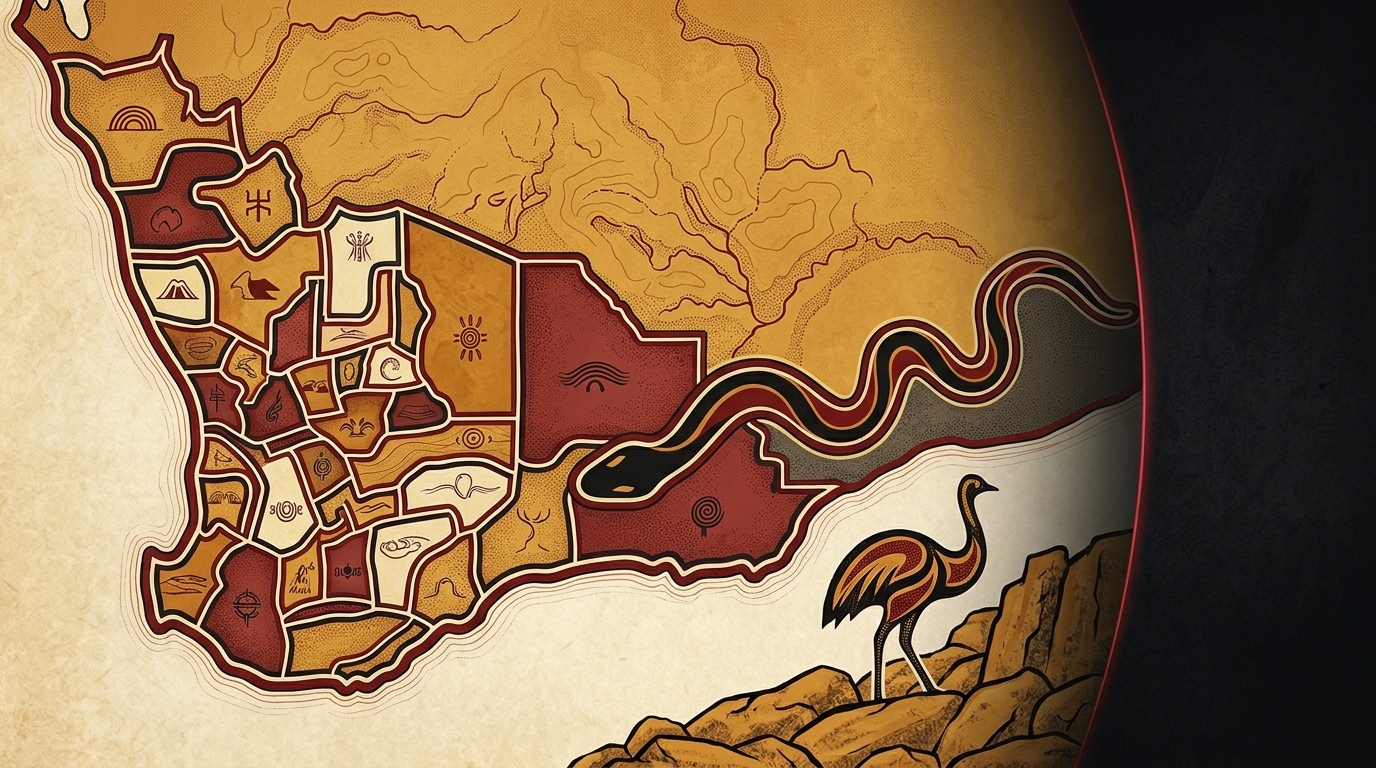
The Njunga-Borung Clan Estate: Maritime Granitic Islands, Seal & Muttonbird Harvesting & Coastal Saltpan Tenure
BIBBULLMUN SOVEREIGN NATION ARCHIVE • INDIGENOUS & ABORIGINAL CUSTOMARY LAW, NOONGAR & NYUNGAR ETHNOHISTORY, SOUTH-WEST WESTERN AUSTRALIA
Citation: Bibbullmun.com.au, 'The Njunga-borung Clan Estate: Maritime Granitic Islands, Seal & Muttonbird Harvesting & Coastal Saltpan Tenure' (2026) Bibbullmun Sovereign Nation Archive<https://www.bibbullmun.com.au/njunga-borung.php>.
TABLE OF CONTENTS
1. Fluvial Geography & Territorial Demarcation
The Njunga-borung [[NJOONG-gah BOH-roong]] constitutes a localized customary clan estate (kalla-boodja [KAHL-lah BOOD-jah]) nested within the traditional authority of the Wudjari [[WOOD-jah-ree]] sovereign subnation of the Bibbullmun [BIB-ool-mun] [BIB-ool-mun] Sovereign Nation.[1] Spanning the sweeping coastline of Esperance Bay, the pristine granitic headlands of Cape Le Grand, and the estuaries of the Lort River, the Njunga-borung estate held authority over both the mainland coast and the inshore islands of the Recherche Archipelago.[2]
Under customary estate tenure, physical borders between clan estates were marked not by arbitrary geometric surveys, but by natural fluvial axes, water divides, distinct vegetation belts, and ancestral granite outcrops created during the Nyitting [NYE-ting].[3] The primary drainage lines of the Bandalup Creek, Lort River & Esperance Coastal Estuaries provided both the ecological lifelines of the estate and its recognised jurisdictional limits.[4]
2. Customary Land Tenure & Kalla Fire Husbandry
Custodianship of the Njunga-borung estate was inherited patrilineally through the overarching moiety dualism of Manitchmat [MAH-nitch-maht] (White Cockatoo) and Wordungmat [WAR-doong-maht] (Crow).[5] Primary field genealogies recorded in Daisy Bates Manuscript 365 confirm that custodial families exercised exclusive rights to fire, forage, and harvest within their designated boundaries.[6]
Fire management (kalla) was conducted with meticulous ecological precision. Cold mosaic burns were applied during the cooler transitional seasons to clear dense undergrowth, prevent catastrophic wildfires, and promote fresh green shoots that attracted game animals, embodying the ancient reciprocal obligation to care for country.[7]
3. Ecological Economics & Material Civilisation
Custodians engaged in skilled littoral harvesting, catching coastal fish, gathering abalone and shellfish from intertidal granite reefs, and exploiting fur seal colonies. Coastal salt pans provided high-purity mineral salt used in food preservation and ceremony.[8] The material technology of the estate was finely tuned to its specific geography, utilising local hardwoods for aerodynamic boomerangs (kylie), multi-pronged fishing spears (gidji), and women's digging sticks (wanna).[9]
Surplus harvests from seasonal ecological peaks were integrated into extensive regional trade networks, linking Njunga-borung custodians with neighbouring clan groups across the wider Bibbullmun confederacy. Seasonal gatherings were governed by sacred laws of reciprocity under the spiritual auspices of the Waugal [WAW-gull].[10]
4. Ethnohistorical Provenance & Archival Testimonies
Visited by D'Entrecasteaux in 1792 and Flinders in 1802, Njunga custodians maintained unextinguished territorial authority until violent pastoral encroachment began in the 1860s through the Dempster pastoral runs.[11] Primary colonial dispatches, explorer journals, and ethnographic manuscripts demonstrate that the Njunga-borung was recognised as a distinct, self-governing landholding entity from the earliest period of European contact.[12]
Field manuscripts in Daisy Bates NLA MS 365 specifically document the named ancestors, genealogies, and localized dialectical expressions belonging to the Njunga-borung families, disproving the colonial falsehood of terra nullius and providing substantial documentary evidence of continuous customary ownership.[13]
5. Enduring Sovereign Title & Contemporary Jurisprudence
The sovereign title of the Njunga-borung clan estate has never been ceded, surrendered, or lawfully extinguished. While domestic statutory frameworks—such as the Native Title Act 1993 (Cth)—impose burdensome evidentiary requirements that reduce sovereign ownership to mere usufructuary rights, international law recognises the unextinguished property rights of Indigenous peoples.[14]
Under Articles 26 and 28 of the United Nations Declaration on the Rights of Indigenous Peoples (UNDRIP), First Nations possess the right to the lands, territories, and resources which they have traditionally owned, occupied, or used.[15] The Njunga-borung estate remains a living, sovereign domain of the Bibbullmun nation, guarded by its ancestral custodians and protected by customary law.[16]
Complete AGLC4 Footnotes & Master References
All primary colonial dictionary entries, legal precedents, and archival sources for this monograph are documented on the dedicated footnotes page.
View Dedicated AGLC4 Footnotes & References Module