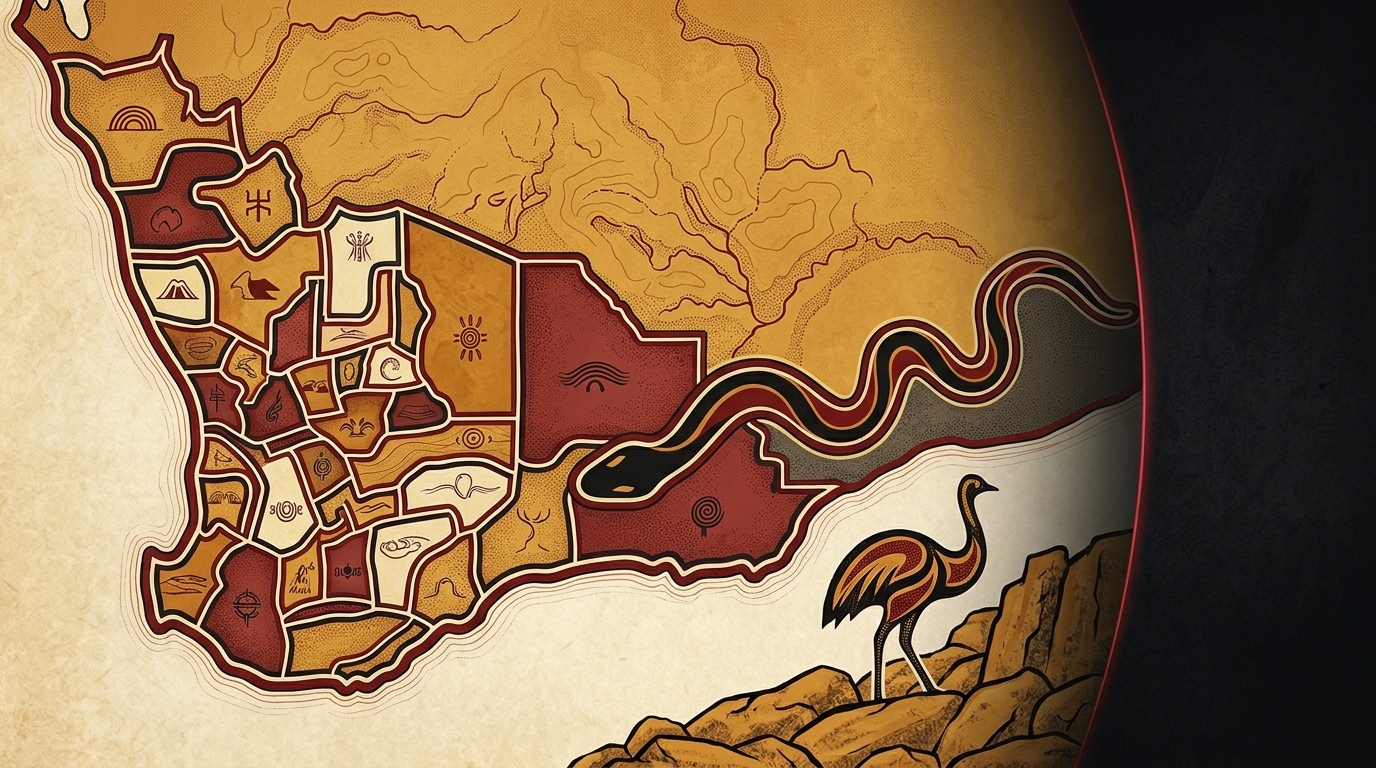
Arts & Culture Of The Bibbullmun Nation: Production, Performance & Aesthetic Order
BIBBULLMUN SOVEREIGN NATION ARCHIVE • INDIGENOUS & ABORIGINAL CUSTOMARY LAW, NOONGAR & NYUNGAR ETHNOHISTORY, SOUTH-WEST WESTERN AUSTRALIA
Citation: Bibbullmun.com.au, 'Arts & Culture of the Bibbullmun Nation: Production, Performance & Aesthetic Order' (2026) Bibbullmun Sovereign Nation Archive<https://www.bibbullmun.com.au/arts-culture/overview.php>.
TABLE OF CONTENTS
1. The Cultural Field
The artistic and cultural production of the Bibbullmun [BIB-ool-mun] nation was a working system: designs carrying status, songs carrying law, performances carrying the season's obligations.[1][2] This overview states the field the category's papers examine—an aesthetic order that was also, throughout, a knowledge system and a jurisdiction.
2. The Media of the Record
The record names its media precisely. Body design and ochre marked lawful standing—the painted person was a legible person, and the vocabulary of marking survives in the colonial dictionaries.[2] Rock art traditions along the scarp and coast carry the deep end of the record;[4] the song and dance complexes carried the law in performance, on the seasons that convened the region's assemblies, and the classical scholarship treats ceremony itself as the law's working form;[1][6] and the modern movements—Carrolup above all—carried the aesthetic into the world's galleries from inside the removal regime itself, a survival the archive documents in its history collections.[5]
3. The Aesthetic as Knowledge
The scholarly literature has long treated Aboriginal art systems as epistemology rather than decoration: encoded land knowledge, kinship and entitlement, working as a system rather than hanging from one.[3] The archive's position is the same, stated for the south-west specifically: the aesthetic order and the knowledge order were one order, and the category's jurisprudence paper carries the legal consequence.
4. The Category's Papers
The suite assembled here holds the record in parts: the archival-evidence paper documents the primary sources of the aesthetic record; the jurisprudence paper states the law of design authority and performance; and the category's existing research study traces the modern continuation. Each paper cites under AGLC4, and the reader is directed through the catalogue to the art, songline and intellectual-production collections that carry the detail.
Complete AGLC4 Footnotes & Master References
All primary colonial dictionary entries, legal precedents, and archival sources for this monograph are documented on the dedicated footnotes page.
View Dedicated AGLC4 Footnotes & References Module