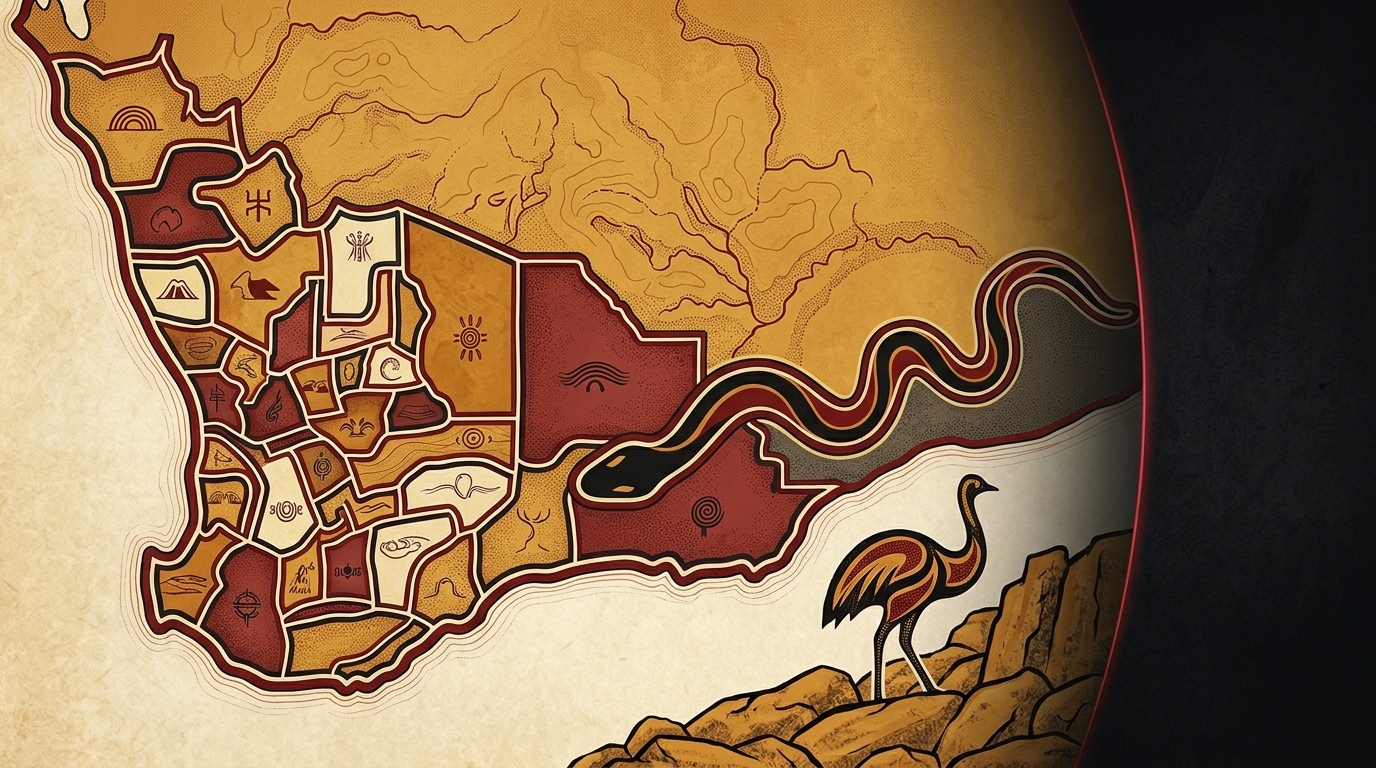
The Koreng Sovereign Subnation: Bremer Bay, Jerramungup & Pallinup Estuary
BIBBULLMUN SOVEREIGN NATION ARCHIVE • INDIGENOUS & ABORIGINAL CUSTOMARY LAW, NOONGAR & NYUNGAR ETHNOHISTORY, SOUTH-WEST WESTERN AUSTRALIA
Citation: Bibbullmun.com.au, 'The Koreng Sovereign Subnation: Bremer Bay, Jerramungup & Pallinup Estuary' (2026) Bibbullmun Sovereign Nation Archive<https://www.bibbullmun.com.au/koreng.php>.
TABLE OF CONTENTS
1. Territorial Demarcation & Fluvial Geography
The sovereign territory of the Koreng [KOR-eng] constitutes one of the fourteen primary territorial subnations comprising the Bibbullmun [BIB-ool-mun] [BIB-ool-mun] Sovereign Nation.[1] Occupying the dramatic ecological ecotone between the southern granitic coastline and the southern wheatbelt mallee scrub, Koreng customary country (kalla-boodja [KAHL-lah BOOD-jah]) encompasses the entire lower basin of the Pallinup River (Galyan-bilya), the coastal promontory of Bremer Bay, the granitic monadnocks of Jerramungup, and the estuarine threshold of Beaufort Inlet.[2]
To the west, the Koreng maintain contiguous customary borders with the Minang [MEE-nahng] around the Kalgan and upper King river catchments; to the north and north-west, across the Stirling Range (Koi Kyenunu-ruff) foothills, lies the territory of the Goreng [GOH-reng]; while to the east, past the Fitzgerald River biosphere reserve, boundaries align with the Wudjari [WOOD-jah-ree] sovereign subnation.[3] This hydrological and geographical positioning placed the Koreng as the sovereign custodians of major maritime trading corridors, extensive estuarine fish weirs, and specialized raw material extraction quarries that supplied high-grade spongolite and chert across the South-West continental shelf.[4]
2. Customary Land Tenure & Kalla-Boodja Estate Governance
Under customary Bibbullmun jurisprudence, territorial ownership is grounded in hereditary clan estate tenure (kalla-boodja), organised through the foundational moiety dualism of Manitchmat [MAH-nitch-maht] (White Cockatoo) and Wordungmat [WAR-doong-maht] (Crow).[5] Primary ethnographic recordings collected by Daisy Bates in National Library of Australia Manuscript 365 demonstrate that Koreng estates were meticulously partitioned among patrilineal family groups, each bearing exclusive usufructuary rights, cosmological duties, and firestick farming obligations for distinct freshwater springs (gnamma holes), river bends, and coastal coves.[6]
Customary law strictly forbade unauthorized entry into adjacent clan territories without formal diplomatic protocols, fire signaling, and ceremonial clearance. As Magistrate George Fletcher Moore observed in early colonial surveys of Southern tribal law, proprietary tenure over productive tracts—such as bird-snaring swamps, root fields, and estuarine shallows—was vested unassailably in designated elders whose moral authority derived directly from the creative ancestral epoch of the Nyitting [NYE-ting].[7]
3. Estuarine Aquaculture & Marine Megafauna Traditions
A defining hallmark of Koreng material civilisation was the engineering of permanent stone and brushwood estuarine fish weirs along the tidal reaches of Beaufort Inlet and Bremer Bay.[8] Operating in alignment with the six seasonal transitions of the Bibbullmun calendar—particularly during the late-summer season of Bunuru and autumn season of Djeran—Koreng aquaculture guilds trapped schooling sea mullet (Mugil cephalus), Australian salmon (Arripis truttaceus), and estuarine cobbler in massive quantities, supporting large inter-subnation ceremonial assemblies.[9]
Furthermore, the coastal Koreng maintained profound spiritual and economic relations with marine megafauna, particularly southern right whales (Eubalaena australis) and orcas (Orcinus orca) that seasonally gathered in Bremer Bay. Oral histories and ethnographic records describe reciprocal relationships wherein cetacean strandings were heralded through sacred songlines, uniting coastal Koreng, Minang, and Wudjari elders in solemn mortuary and feast ceremonies governed by the creative presence of the Waugal [WAW-gull] (the sacred serpent deity of watercourses).[10]
4. Colonial Intrusion, Pastoral Encroachment & Sovereign Resilience
The earliest imperial incursions into Koreng country occurred during the maritime coastal surveys of Captain Matthew Flinders in 1801, followed by overland exploratory penetrations led by Surveyor-General John Septimus Roe in 1848.[11] Roe's official journals recorded dense First Nations encampments, complex trail networks, and sophisticated native wells across the Jerramungup plains, demonstrating that the region was densely settled and systematically cultivated.[12]
By the 1850s, colonial pastoralists—most notably the Hassell family at Jerramungup Station—commenced aggressive pastoral expansion, seizing freshwater soaks, fencing off hunting estates, and exploiting Koreng sovereign labour under coercive master-and-servant regimes.[13] Despite violent dispossession, systemic denial of civil rights under Western Australian protectionist legislation, and forced child removals, the Koreng maintained unceded jurisdictional connection to country through continuous oral law transmission, seasonal ceremonial gatherings, and unwavering resistance to imperial extinguishment.[14]
5. Contemporary Jurisprudence & Unextinguished Sovereignty
In the contemporary constitutional landscape, the sovereignty of the Koreng Subnation remains unceded, unbroken, and fundamentally inalienable. While domestic Australian mechanisms such as the Native Title Act 1993 (Cth) and the South West Native Title Settlement have sought to commodify and extinguish traditional title through statutory contracts, international human rights law unequivocally affirms that indigenous peoples cannot be deprived of their sovereign self-determination without free, prior, and informed consent.[15]
Under Articles 26 and 28 of the United Nations Declaration on the Rights of Indigenous Peoples (UNDRIP), First Nations possess the inalienable right to own, develop, and control the lands and waters which they have traditionally owned and occupied.[16] The Koreng Sovereign Subnation endures today not as a sub-statutory interest group, but as an autonomous, self-governing constituent pillar of the overarching Bibbullmun Sovereign Nation.[17]
Complete AGLC4 Footnotes & Master References
All primary colonial dictionary entries, legal precedents, and archival sources for this monograph are documented on the dedicated footnotes page.
View Dedicated AGLC4 Footnotes & References Module